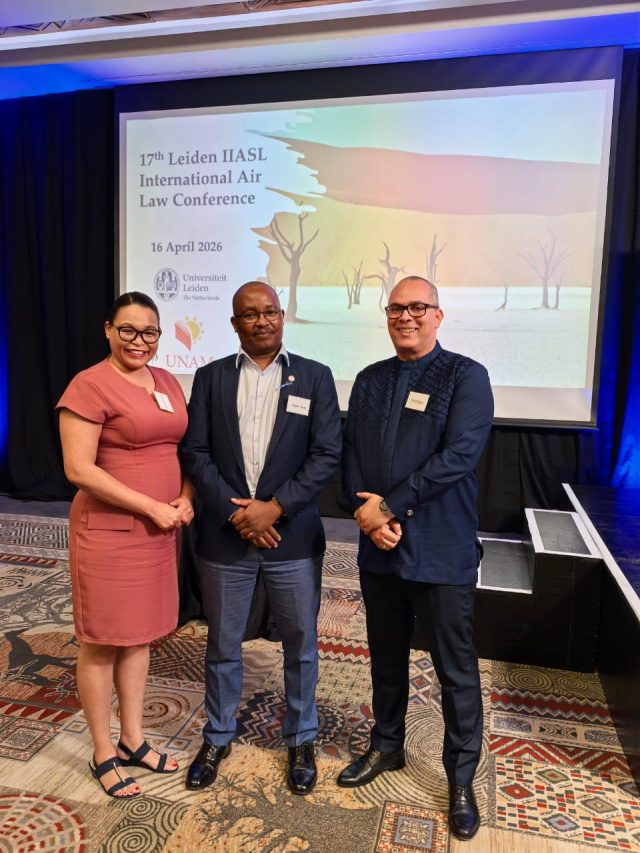
Windhoek, Namibia: There are moments in the evolution of a sector when conversation shifts from the abstract to the practical – when ideas begin to take institutional shape. The gathering held on 16 April 2026 in Namibia was one such moment for African aviation.
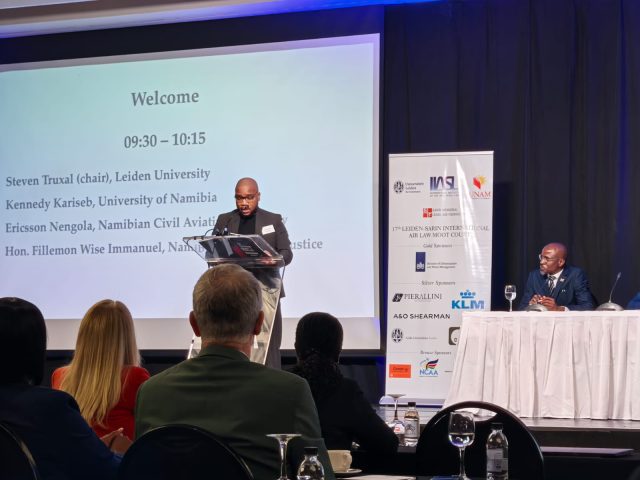
Opened by the Minister for Justice, Filemon Immanuel, the event set an important tone: aviation is no longer the exclusive domain of transport ministries or industry insiders. It is a cross-cutting developmental question, implicating law, policy, finance, education, and ultimately, the trajectory of African economies. The structure of the programme itself reflected this breadth – a focused one-day conference followed by a three-day aviation law moot court competition, signalling a deliberate effort to bridge theory and practice.
In welcoming delegates, Steven Truxal, Director of the International Institute of Air and Space Law at Leiden University, underscored a historic milestone: the moot court competition was being hosted in Africa for the first time. This was not a symbolic gesture. It was a recognition that the continent must increasingly become a site of knowledge production, not merely consumption.
This theme found resonance in the contributions from local stakeholders. Dr Kennedy Kariseb of the University of Namibia highlighted the growing importance of academia-industry collaboration, while Ericsson Nengola of the Namibia Civil Aviation Authority made a compelling case for demystifying aviation law – arguing that its perceived elitism continues to exclude critical voices and slow sectoral growth.
The first panel on Regional Connectivity and Liberalisation brought into sharp focus one of the most persistent challenges in African aviation: sovereignty. Despite longstanding continental instruments such as the Yamoussoukro Decision and the Single African Air Transport Market (SAATM), implementation remains uneven. The discussion revealed a familiar tension – the desire by states to “fly the flag” and maintain control over national carriers, often at the expense of broader economic integration.
UNISA’s Prof Angelo Dube indicated that this reluctance extends beyond market access. It manifests in fragmented approaches to training, licensing, and certification, effectively limiting mobility within the sector. The result is a paradox: a continent that speaks of integration, yet remains structurally disjointed in practice.
“Resolving this fragmentation requires a shift in how we conceptualise aviation governance. Too often, continental dialogues are confined to Ministers of Transport. Yet aviation intersects with tourism, agriculture, trade, finance, justice, and higher education. Without a coordinated, multi-ministerial approach, meaningful reform will remain elusive”, Dube added.
It is within this context that the role of universities becomes particularly significant. Institutions such as UNISA are beginning to reposition themselves – not as peripheral commentators, but as active participants in shaping the sector. The development of specialised programmes, as well as practical investments such as the acquisition of airport infrastructure, signals a move towards embedding aviation within the academic core.
The supervision and graduation of doctoral candidates in areas such as unruly passenger regulation and accident investigation frameworks further illustrates the point. These are not abstract research topics; they are responses to real regulatory and operational challenges facing the industry. Academia, when properly aligned, can serve as both a think tank and a pipeline for sectoral expertise.
The conversation on aircraft finance, particularly in relation to the Cape Town Convention, reinforced this need for deeper engagement. Questions of asset security, cross-border leasing, insurance, and registration are central to unlocking investment into African aviation. Yet these remain underdeveloped areas within many academic curricula. There is a clear opportunity – and indeed responsibility – for universities to develop targeted programmes that address these gaps.
Equally compelling was the fireside discussion featuring Daniel Moss from the African Airlines Association, who highlighted the interconnectedness of SAATM and the African Continental Free Trade Area (AfCFTA). In essence, his contribution highlighted that liberalising air transport is not an isolated objective; it is integral to facilitating trade, movement, and economic growth across the continent.
Moss also touched on the emerging discourse around decarbonisation and sustainable aviation fuels (SAF). While production on the continent has yet to take off, the recent development of policy guidelines suggests that Africa is beginning to engage with the global sustainability agenda. This is another area where early academic and policy alignment will be critical.
The panel on Drones and High Altitude Platform Systems (HAPS) offered a glimpse into the future – and the regulatory uncertainties that accompany it. The absence of a universally accepted definition of HAPS complicates efforts to develop coherent legal frameworks. Similarly, the rapid proliferation of drones, coupled with incidents of unsafe operations, has exposed gaps in unmanned traffic management systems.
Here again, the message was consistent: the pace of technological advancement is outstripping regulatory development. Addressing this imbalance will require sustained research, interdisciplinary collaboration, and a willingness to experiment with new governance models.
As the conference transitions into the moot court phase, one is reminded that the future of African aviation will be shaped not only in boardrooms and ministries, but also in classrooms and courtrooms. The task ahead is to ensure that these spaces remain connected – that ideas generated in one find expression in the other.
If there is a single takeaway from this gathering, it is this: Africa does not lack talent, or ambition, and arguably, frameworks. What it requires is alignment – across states, sectors, and institutions. Only then can the promise of an integrated African sky be realised.
About the Author:
At the intersection of cockpit, courtroom, and classroom, Prof Angelo Dube brings a rare, lived perspective to aviation. A commercial pilot and Chief Executive Officer of Flying Jurist, he is also the driving force behind the Aviation Indaba – an influential platform shaping high-level industry dialogue across the continent.
In the global legal arena, he serves as President of the Society for International Aviation Law, while in academia he holds the position of Professor of International Law within the School of Law at UNISA. There, he leads the Aviation Law Working Group – a dynamic collective of pilots, regulators, researchers, and legal minds pushing the boundaries of aviation law and policy.
He writes here not from a single vantage point, but from the confluence of them all – and in his personal capacity.