
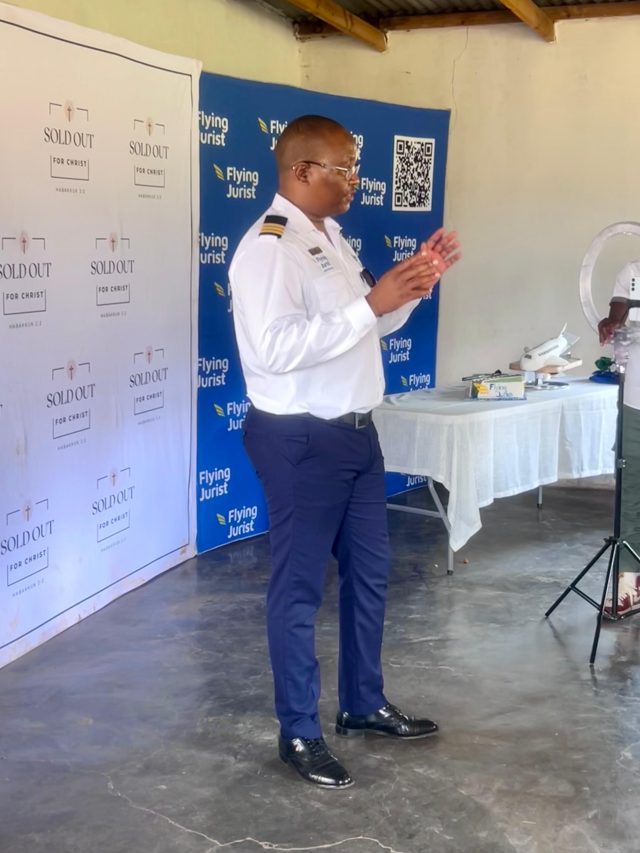
Leribe, Lesotho: On the weekend of 7 and 8 February 2026, our team at Flying Jurist had the privilege of rolling out a capacity-building and career-guidance engagement with young people from Sold Out for Christ Ministries in Butha-Buthe, in the Kingdom of Lesotho. The invitation came from the ministry’s leader, Prophet Jeremiah Nkosi, with the blessing of the local chief. Nkosi’s passion for youth development resonated deeply with our own commitment to meaningful, community-centred impact. It provided Flying Jurist with an opportunity to impact youth outside South African borders.
Butha-Buthe is framed by low-lying hills that cradle the valley in quiet dignity. Sitting at about 5 300 feet above sea level, Leribe Airport (FXLR) lies nearby, nestled between peaks towering up to 9000ft – abandoned, weathered, yet filled with promise. For many young people in the area, this airfield is the closest tangible encounter with aviation they have ever had. To us, it stands as both a reminder of Lesotho’s aviation past and a beacon for what could still be built. It is also worth noting that it is not just an aviation artefact of yesterday, but also a runway of hope for tomorrow.
During the engagement, I had the opportunity – both as CEO of Flying Jurist and as a commercial pilot – to speak to youth – ranging from primary school to university level about the breadth of careers that exist within aviation. We spoke about becoming a pilot, cabin crew member, aircraft maintenance engineer, air traffic control, and the many other professions that make aviation work. What stood out most was not my presentation, but the quality of the questions. The young people were curious, sharp, and deeply engaged. Their questions reflected ambition, but also a desire for practical pathways – how do I get there, and what does it really take?
The weekend coincided with my birthday, which the young people marked with warmth and generosity. I was surprised with an aviation-themed cake, baked by our hosts, and we celebrated together in a way that reminded me why this work matters. Moments like those affirm that mentorship and exposure can ignite confidence and possibility in ways no textbook ever could.
Lesotho’s mountainous terrain presents daily challenges to mobility and access. Roads are often long, winding, and vulnerable to weather conditions. In winter, snow can disrupt transportation and logistics, isolating communities and delaying the movement of goods and people. This reality invites important questions that deserve serious national reflection:
- Lesotho’s nominal GDP is estimated at approximately $2.4 billion to $2.6 billion USD for 2025. Although there is no comprehensive published figure specifically isolating aviation’s direct contribution to Lesotho’s GDP, a combined road and air transport contribution accounted for about 102.78 million Lesotho Maloti to GDP in early 2025. Lesotho’s aviation contribution to GDP remains very modest and this is largely due to the sector being small, under-served and at an early stage of revitalisation.
- Snowfall and winter freezes can make roads treacherous, particularly in the highlands, increasing the risk of closures, impassable stretches, and slowed transport. Needless to say, this leads to delays in delivery and slows down the economy. These delays can also increase freight costs and lead to service reliability drops.
- Beyond transport, aviation can be strategically used for disaster management, medical logistics, and time-sensitive deliveries – especially through emerging technologies such as drones.
There is little doubt in my mind that aviation can play a transformative role in Lesotho. Whether through manned aircraft connecting hard-to-reach regions, or unmanned aerial systems delivering critical supplies, the potential is real. What is needed is vision, policy coherence, infrastructure investment, and, most importantly, people. The youth of Butha-Buthe reminded me that the human capital is already there, waiting to be inspired and enabled.
If we are serious about inclusive development and economic resilience, then reigniting and stimulating the aviation sector in the Kingdom of Lesotho should not be a distant dream. It should be a deliberate, collaborative project, one that begins with exposure, education, and belief.
And sometimes, that journey starts with a conversation near a quiet runway.
Prof Angelo Dube (Commercial Pilot) is a Professor of International Law, Acting Director of the School of Law at UNISA, and Chief Executive Officer at Flying Jurist, and founder of the Aviation Indaba. At UNISA he heads the Aviation Law Working Group, a consortium of pilots, aviators, researchers and lawyers who research in various aspects of aviation law. He writes here in his personal capacity.


2 comments
Esther Ninela
20 February 2026 at 6:06 am
Good morning and Overcome Today.
The vision has come to pass, Glory be to God
Weeeeeeeeeee Jessssuuuuuuuu!!!!!!!!
Masentle Makhetha
20 February 2026 at 7:40 am
That’s wonderful to hear. ✈️ My home. The Kingdom in the Sky. The Mountain Kingdom . There absolutely is hope for aviation in Lesotho, especially for young people who are passionate and willing to pursue the path seriously.
With assets like Moshoeshoe I International Airport and the uniquely challenging terrain that makes flying in Lesotho both demanding and special, the country actually has strong potential to develop skilled pilots, engineers, air traffic controllers, and aviation entrepreneurs.
The future of aviation in Lesotho can be bright if the youth continue to pursue it with dedication and vision.
Mosebetsi o motle o makhethe Captain Dube