
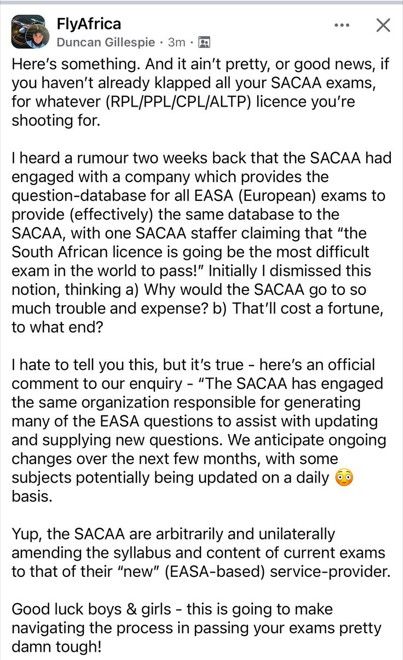
Johannesburg, South Africa: In a time when misinformation spreads faster than the speed of sound, the South African Civil Aviation Authority (SACAA) has once again demonstrated the importance of regulatory integrity and factual accuracy. A recent post in the closed Facebook group, Fly Africa, attempted to incite unwarranted panic within the aviation community by falsely claiming that SACAA was in the process of unilaterally overhauling the entire aviation training syllabus—from Private Pilot Licence (PPL) to Airline Transport Pilot Licence (ATPL)—in favour of a European Union Aviation Safety Agency (EASA)-styled curriculum. According to the post, this change would make South African pilot training one of the most expensive and complex in the world, effectively limiting access and progression in the industry.
Such claims, however, could not be further from the truth. In a swift and firm response, the SACAA issued a public statement debunking these allegations and reaffirming its commitment to due process and transparency in regulatory changes. The authority clarified that no changes had been made to the syllabus or examination framework and that any future adjustments would undergo extensive industry consultation and rigorous testing before implementation.
The dangerous game of misinformation
As a pilot, an academic and legal expert who has spent years advocating for progressive aviation policies, I have witnessed the tangible impact of misinformation in this sector. False narratives, especially those circulated under the guise of industry insights, not only erode public confidence but also stifle the transformative efforts aimed at making aviation more inclusive and accessible. The Fly Africa post is a prime example of how unverified information can sow discord, discourage aspiring aviators, and fuel unnecessary resistance against positive regulatory advancements.
While freedom of expression is enshrined in Section 16 of the South African Constitution, it comes with the responsibility of ensuring that statements made in public forums are truthful and verifiable. The aviation industry, much like any other highly technical and safety-sensitive domain, cannot afford the luxury of baseless speculation masquerading as fact. The damage caused by such misinformation extends beyond social media—it seeps into boardrooms, training institutions, and the broader regulatory landscape, influencing perceptions in ways that may ultimately hinder progress.
SACAA’s due process: a model of regulatory integrity
One of the most reassuring aspects of the SACAA’s response is its emphasis on proper procedure. The authority highlighted that any modification to the aviation syllabus must follow an extensive consultative process involving industry stakeholders, training institutions, and regulatory bodies. Furthermore, changes of this magnitude would necessitate a thorough evaluation to ensure alignment with both national and international aviation safety standards.
This level of scrutiny is not unique to South Africa; it is a global best practice. Regulatory frameworks in aviation are deliberately designed to evolve through structured, evidence-based deliberations, not through knee-jerk reactions to speculative assertions on social media. The SACAA’s prompt and decisive rebuttal of these falsehoods should serve as a reminder that aviation policy and training standards are too critical to be subjected to the whims of online rumour mills.
The broader context: transformation in aviation
It is no secret that South Africa’s aviation industry remains one of the most racially and gender-stratified sectors of the economy. For years, efforts to transform and democratize access to this field have faced numerous hurdles, not least of which is the resistance from those who benefit from maintaining the status quo. Unfortunately, some pockets of the industry have become echo chambers where any discussion of change—whether in training models, access to funding, or diversity initiatives—is met with scepticism or outright hostility.
Fly Africa, a closed group known for its selective membership and often controversial discussions, has repeatedly been at the centre of such resistance. While it is expected that industry professionals will have varying perspectives on regulatory issues, the deliberate dissemination of misinformation is a disservice to aviation as a whole. It detracts from genuine debates on how best to enhance South Africa’s aviation ecosystem and ensure that it remains competitive on a global scale.
A call for responsible discourse
Aviation, by its very nature, is built on precision, accuracy, and trust. These principles should extend beyond flight operations into how we communicate about the industry. While critical engagement with regulators is not only necessary but encouraged, it must be conducted in a manner that is constructive, factual, and solution-oriented.
Regulatory bodies like the SACAA play a crucial role in upholding safety standards, promoting industry growth, and ensuring compliance with international aviation frameworks. Attempting to undermine their credibility through misinformation only serves to weaken the entire sector. Instead, industry professionals, training institutions, and aviation enthusiasts should foster open, fact-based dialogues that contribute meaningfully to shaping a robust and progressive regulatory environment.
Conclusion
The recent statement by the SACAA is more than just a rebuttal to a misleading Facebook post—it is a reaffirmation of the regulator’s commitment to due process, industry consultation, and factual integrity. The aviation sector must guard against the reckless spread of misinformation, particularly in spaces where transformation efforts are already met with undue resistance.
As team Flying Jurist, we urge all aviation stakeholders to engage responsibly, verify their sources, and prioritize accuracy in their contributions to industry discourse. In doing so, we uphold the very principles that make aviation a beacon of excellence—rigor, accountability, and progress.
Let us navigate the skies of truth, rather than be grounded by the weight of falsehoods.
Prof Angelo Dube


