Johannesburg, South Africa: The inaugural African Aviation Law Moot Court Competition, held at Constitution Hill in Johannesburg, specifically in the historic Atrium of the Women’s Jail, was established for a much bigger purpose than simply giving law students another competition.
The underlying idea was to build an African pipeline of lawyers who understand aviation law and can contribute meaningfully to the development of Africa’s aviation sector.
There are several connected reasons:
1. To develop the next generation of African aviation lawyers
Aviation is one of the most legally complex and internationally regulated industries, yet aviation law remains a relatively specialised field within African legal education. The competition was designed to expose students to real aviation-law problems, legal research, written advocacy and oral argument.
The objective is ultimately to develop a generation of African lawyers who can engage confidently with the legal issues arising from aircraft operations, international air transport, regulation, safety, liability, airports, emerging aviation technologies and the rapidly changing aviation economy.
The competition is a Flying Jurist initiative, conceived as part of Flying Jurist’s broader commitment to developing aviation-law capacity on the African continent. It is implemented through Flying Jurist’s implementation partner, the Lenono Foundation, reflecting a deliberate model of collaboration between industry, civil society and academia.

2. To move aviation law from the classroom into practice
A moot court forces students to confront the kinds of disputes and legal questions that arise in the real aviation environment. The African Aviation Law Moot Court Competition was therefore designed to connect academic knowledge with the realities of the aviation industry. Students are not merely learning legal principles. They are being asked to research, interpret, argue and defend positions on complex aviation questions before experienced practitioners and members of the judiciary.
This is important because aviation law cannot be developed in isolation from aviation itself. The lawyers who will regulate, advise, litigate and shape the industry must understand the industry they seek to regulate.

3. To democratise aviation law
Aviation law is sometimes perceived as an elitist or inaccessible field. The competition seeks to change that. By bringing aviation law directly into universities and creating a continental platform for students from different institutions, the initiative seeks to make aviation law more accessible to young African lawyers. It is about saying to students across the continent: aviation law is also your field; Africa needs you in it.
The inaugural competition brought together students, academics, practitioners, judges, industry leaders and civil-society actors in a single forum. That interaction is itself an important part of developing the next generation of aviation professionals.
4. To create an African intellectual community around aviation law
The competition brings universities, students, academics, practitioners, judges, regulators and industry together.
That matters because Africa’s aviation challenges cannot be solved by regulators or airlines alone. They require lawyers, policymakers, academics, engineers, economists, pilots, aviation professionals and industry leaders who understand the same problems and can work across institutional boundaries.
The competition therefore seeks to build more than individual legal skills. It seeks to build an African aviation-law community.
The inaugural event demonstrated what is possible when institutions work together.
The support of the University of Johannesburg’s SAIFAC was particularly valuable. SAIFAC made available a boardroom which served as the judges’ chambers, providing an appropriate professional environment for the judges’ deliberations and underscoring the importance of academic institutions supporting practical legal education.
5. To support African aviation integration
The competition sits within a much larger continental project: the development of an integrated African aviation market through instruments such as the Yamoussoukro Decision and the Single African Air Transport Market (SAATM).
These initiatives require lawyers who understand international air law, regional integration, market access, regulatory harmonisation and the complex relationship between national sovereignty and continental economic integration.
Africa’s aviation ambitions will require not only aircraft, airports, airlines and infrastructure, but also legal systems and legal professionals capable of supporting those ambitions.
The African Aviation Law Moot Court Competition is therefore part of the intellectual infrastructure required to support the future of African aviation.
6. To make Africa a producer of aviation-law knowledge, rather than merely a consumer of it
This is perhaps the most important philosophical reason. The establishment of an African-based aviation-law moot court is significant because international aviation-law education and specialist competitions have historically been concentrated elsewhere. Africa should not merely import aviation-law knowledge. Africa must produce it. Industry has an important role in this process.
The traditional separation between “academia” and “industry” is increasingly inadequate when dealing with complex fields such as aviation. The aviation industry encounters emerging legal, technological, commercial and regulatory questions every day. Industry is therefore not merely a consumer of knowledge produced by universities. Industry itself is a producer of knowledge.
Flying Jurist’s establishment of the competition reflects this philosophy.
Under the leadership of Distinguished Prof. Angelo Dube and Group CEO at Flying Jurist, the company has sought to position the aviation industry as an active participant in knowledge creation, legal education and professional development. The initiative demonstrates that an aviation business entity and industry organisation can play a meaningful role in identifying emerging challenges, developing academic platforms around those challenges and creating opportunities for young professionals to engage with them.
It is also about recognising that industry has a responsibility to help create the next generation of aviation professionals. The lawyers of tomorrow will advise airlines, airports, aircraft operators, regulators, lessors, manufacturers, governments and international organisations. They must therefore begin developing an understanding of aviation long before they enter those institutions.
7. The competition demonstrates the power of civil society and industry collaboration
Perhaps one of the most important features of the inaugural competition was the collaborative model through which it was delivered.
The competition is a Flying Jurist initiative, implemented through its implementation partner, the Lenono Foundation under the leadership of the Foundation’s CEO, Adv Konanani Raligilia. That relationship is an example of how civil society and industry can work together to deliver interventions that neither sector could necessarily achieve as effectively on its own.
Flying Jurist brings aviation-law expertise, industry networks, professional experience and the vision for the initiative.
The Lenono Foundation provides an important civil-society implementation platform through which the initiative can advance its developmental and educational objectives.
The result is a model in which industry expertise, civil-society purpose and academic engagement converge. That model was strengthened by the generous support of the competition’s sponsors and partners.
CSIR, CJ Ntsoane Attorneys and Cliffe Dekker Hofmeyr (CDH) played a critical role in making the inaugural competition possible. Their support represents more than sponsorship. It is an investment in the development of African professional capacity and in the creation of platforms through which young people can engage with sophisticated areas of law and industry.
The contribution of sponsors in initiatives such as this is particularly important because building professional capacity cannot be left to universities alone. It requires the active participation of the institutions that will ultimately employ, regulate, advise and work alongside the professionals being developed.
The competition therefore stands as an example of what can happen when industry, civil society, academia and the legal profession take collective responsibility for developing Africa’s future talent.

8. Bringing the judiciary and practising profession into the learning environment
The involvement of experienced practitioners and members of the judiciary gave the competition a particularly important dimension.
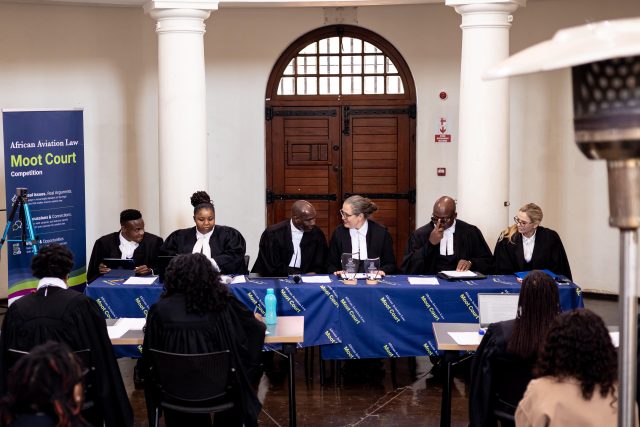
The finalists were judged by an impressive panel drawn from the judiciary, aviation industry and legal profession, including Judge Du Plessis, Judge of the High Court in Johannesburg; Mr Lot Haifidi, Chief Legal Officer at Airports Company Namibia; Mr CJ Ntsoane; Adv Anne-Lize Lourens from the Society for International Aviation Law; Adv. Malapane; and Adv. Mamoepa.
Their participation ensured that the students were not simply arguing before academics. They were tested by people who understand advocacy, legal practice, aviation and the realities of professional decision-making.
For the students, this created an invaluable opportunity to experience the standards expected in real legal practice.
For the profession, it created an opportunity to identify and encourage emerging talent.
And for the industry, it created a direct role in shaping the professionals who will eventually advise and regulate it.
9. And Constitution Hill was a particularly powerful choice
Holding the competition in the Atrium of the Women’s Jail at Constitution Hill gave the competition a meaning beyond aviation and law. Constitution Hill represents South Africa’s history of law, injustice, human dignity, constitutionalism and transformation.Bringing young African lawyers into that space to argue questions of aviation law created a powerful juxtaposition:
A place where law was once used as an instrument of exclusion became a place where young Africans were using law as an instrument of knowledge, participation and transformation.
That symbolism is central to what the competition seeks to achieve.
The objective is not simply to produce better mooters.
It is to produce better lawyers, better aviation professionals and ultimately better contributors to Africa’s development.
An African aviation-law institution in the making
The inaugural African Aviation Law Moot Court Competition was therefore established for a purpose considerably larger than the competition itself.
It seeks to develop Africa’s next generation of aviation-law practitioners and scholars; strengthen legal capacity for an increasingly integrated African aviation market; create a continental platform for African students to develop research and advocacy skills; encourage universities and industry to collaborate; and establish a culture in which the aviation industry actively participates in the production and dissemination of knowledge.
Most importantly, it demonstrates that industry has a role in education, civil society has a role in professional development, and universities have a role in connecting knowledge with practice.
The collaboration between Flying Jurist and the Lenono Foundation provides a practical example of this philosophy in action.
The success of the inaugural competition is therefore not simply measured by the quality of the arguments in the courtroom. It is measured by the relationships created, the young professionals exposed to aviation law, the institutions brought together and the foundation laid for a much larger African aviation-law community.
The first competition was held in the historic Women’s Jail at Constitution Hill.
The next chapter belongs to the continent.
The 2027 African Aviation Law Moot Court Competition will be even grander — expanding the platform, deepening industry and academic participation, reaching more universities and developing an even larger community of young African aviation-law professionals.
What began as an initiative of Flying Jurist, implemented through the Lenono Foundation, has the potential to become a defining annual institution in African aviation-law education.
The future of African aviation will require aircraft, infrastructure, technology, investment and connectivity. But it will also require people — and the African Aviation Law Moot Court Competition is helping to develop the lawyers and professionals who will build that future.
About the Author:
At the intersection of cockpit, courtroom, and classroom, Dist. Prof Angelo Dube brings a rare, lived perspective to aviation. A commercial pilot and the Group Chief Executive Officer of Flying Jurist, he is also the driving force behind the Aviation Indaba – an influential platform shaping high-level industry dialogue across the continent.
In the global legal arena, he serves as President of the Society for International Aviation Law, while in academia he holds the position of Distinguished Professor (Aviation and Aeronautical Studies) within the College of Law at UNISA. There, he leads the Aviation Law Working Group – a dynamic collective of pilots, regulators, researchers, and legal minds pushing the boundaries of aviation law and policy. Prof Dube is also a founding member of the Engaged Scholarship on the Rural Aviation Economy (Project ESRAE) which seeks to optimise rural communities’ access to the aviation economy across South Africa.
He writes here not from a single vantage point, but from the confluence of them all – and in his personal capacity.