Johannesburg, South Africa: The South African Civil Aviation Authority (SACAA) released its Annual Report for 2025/26 at the beginning of October 2026. The report reflects efforts to maintain a safe, resilient and sustainable aviation sector. At Flying Jurist, however, our interest extends beyond regulatory performance. We are equally concerned with the constitutional and international law imperatives of transformation, including gender equality and equitable racial representation.
The International Civil Aviation Organisation (ICAO), through initiatives including Resolutions A39-30 and A41-26, has called for greater gender equality in aviation by 2030. The United Nations Sustainable Development Goals similarly advance gender equality and women’s empowerment. SACAA has contributed through initiatives such as the National Aviation Conference, the ICAO Next Generation of Aviation Professionals Conference held in Durban in 2025, and support initiatives including funding and bursaries.
Yet South Africa’s historical exclusion of Black people from many professions continues to shape the industry’s demographic profile. Black in this instance includes African, Coloured and Indian persons. Transformation must therefore remain central to how we interpret aviation statistics and formulate policy.
What do the numbers tell us?
As at 31 March 2026, SACAA recorded 28,435 South African aviation personnel licence holders, representing year-on-year growth of 6.7%. The figures extend beyond pilots to include other occupational categories such as cabin crew, air traffic controllers and aircraft maintenance personnel. A further 7,199 foreign licence holders were reported separately.
Women accounted for 6,366 South African licence holders, approximately 22% of the total, compared with 22,069 men, or 78%. This remains a considerable distance from the ambition of gender parity in aviation.
The racial distribution is equally instructive. White licence holders accounted for 17,373, or 61.1% of the total. African licence holders numbered 8,408 (29.6%), followed by Coloured licence holders at 1,569 (5.5%) and Indian licence holders at 1,076 (3.8%).
These figures must be interpreted carefully. They represent licence holders, not necessarily people currently employed in aviation or actively exercising their licence privileges. Nevertheless, they provide an important starting point for examining representation.
The professional pilot pipeline
Commercial Pilot Licences (CPLs) and Airline Transport Pilot Licences (ATPLs) offer a useful lens through which to examine access to professional piloting.
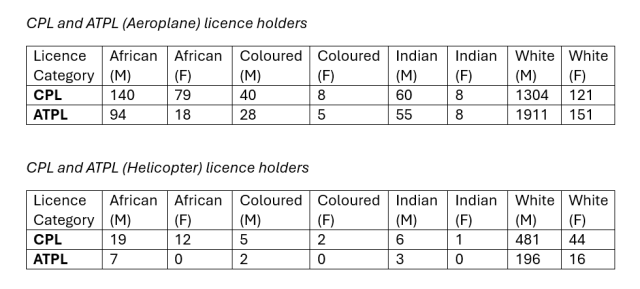
For aeroplane licences, the report records 140 African men and 79 African women holding CPLs, compared with 94 African men and 18 African women holding ATPLs. Among White licence holders, the corresponding figures are 1,304 men and 121 women for CPLs, and 1,911 men and 151 women for ATPLs.
The helicopter figures reflect a similar disparity. There are 19 African men and 12 African women holding helicopter CPLs, compared with 481 White men and 44 White women. For helicopter ATPLs, the figures are seven African men and no African women, compared with 196 White men and 16 White women.
These figures raise important questions about access to training, career progression, financing and the professional pathways through which pilots advance. They do not, on their own, establish the reasons for the disparities. Further research is required to understand the barriers and opportunities across the licensing pipeline.
Are drones changing the picture?
Remote Pilot Licences (RPLs) provide another interesting dimension. SACAA records 3,804 remote-pilot licence holders: 2,873 men and 931 women.
African women account for 754 holders, Coloured women 54, Indian women 19 and White women 104. African women therefore represent approximately 19.8% of all RPL holders, while women across all four population groups account for approximately 24.5%.
The relatively accessible entry points offered by some drone operations may create opportunities to broaden participation in aviation. However, the figures alone cannot establish whether remote piloting is transforming access or reducing historical inequalities. That question deserves closer investigation, particularly as unmanned aviation expands into agriculture, logistics, research and other applications.
Transformation requires more than regulation
SACAA’s statistics are valuable, but aviation is a multidisciplinary field extending beyond the regulator’s immediate mandate. Aviation medicine, law, finance, economics, engineering and aeronautics all contribute to the sector’s development, and each has its own professional pathways and demographic profile.
Consider aviation medicine. A practitioner must first qualify as a medical practitioner before undertaking the additional requirements for accreditation as a Designated Aviation Medical Examiner (DAME). These professionals play a critical role in determining the medical fitness of pilots, cabin crew and other aviation personnel. Yet a fuller assessment of transformation requires information about who enters and progresses through this specialised profession.
Similar questions arise in aviation law, aircraft maintenance, aviation finance and aeronautical research. Without reliable, disaggregated data, it is difficult to establish where exclusion persists, evaluate interventions or develop evidence-based policy.
The responsibility cannot rest with SACAA alone. Government departments, industry associations, civil society, professional bodies and universities must contribute to a broader aviation research agenda. Higher education institutions, in particular, are well positioned to undertake multidisciplinary research that connects demographic representation with education, professional accreditation, employment and career progression.
The way forward
We commend SACAA for publishing statistics that provide a useful basis for examining the state of South African aviation. The 2025/26 figures demonstrate growth in the licensed population, but they also reveal persistent disparities in gender and racial representation.
The next step for all aviators is to move beyond counting licence holders towards understanding the pathways, barriers and institutional conditions that shape participation across the aviation value chain.
Transformation is not a task for the regulator in isolation. It requires coordinated action, reliable data and sustained commitment from every stakeholder with a role in the industry.
A safe and globally competitive aviation sector is essential. So, too, is an aviation sector in which opportunity is not determined by gender, race or historical exclusion. The challenge before us is to pursue both objectives with equal seriousness.
About the Author:
At the intersection of cockpit, courtroom, and classroom, Dist. Prof Angelo Dube brings a rare, lived perspective to aviation. A commercial pilot and the Group Chairman of the Flying Jurist Group of Companies, he is also the driving force behind the Aviation Indaba – an influential platform shaping high-level industry dialogue across the continent.
In the global legal arena, he serves as President of the Society for International Aviation Law, while in academia he holds the position of Distinguished Professor (Aviation and Aeronautical Studies) within the College of Law at UNISA. There, he leads the Aviation Law Working Group – a dynamic collective of pilots, regulators, researchers, and legal minds pushing the boundaries of aviation law and policy. Prof Dube is also a founding member of the Engaged Scholarship on the Rural Aviation Economy (Project ESRAE) which seeks to optimise rural communities’ access to the aviation economy across South Africa.
He writes here not from a single vantage point, but from the confluence of them all – and in his personal capacity.