Johannesburg, South Africa: There was something rather appropriate about discussing the future of Muldersdrift and Lanseria on 1 September 2026 while a C172 and a Sling 2 went through their circuit overhead, on the left downwind of Runway 07, punctuated every now and then by the deeper sound of a King Air on a straight-in approach.
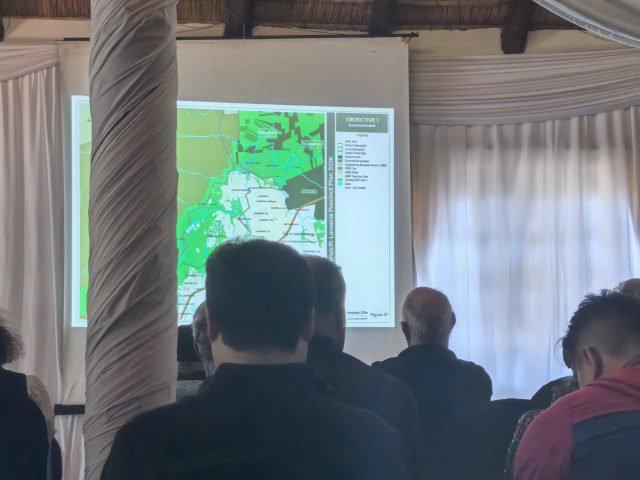
The engagement was held at the Valverde Eco Hotel, located abeam the approach to Lanseria International Airport, where Mogale City Local Municipality presented the developing Muldersdrift–Lanseria Precinct Plan to residents, industry representatives, developers and other stakeholders.
The timing is significant. Mogale City has long identified Muldersdrift as a strategic growth area, positioned between Johannesburg, Tshwane and the Lanseria node, with the N14 increasingly functioning as a development corridor. Its own planning documents identify the Lanseria Smart City, the N14 corridor, economic development and the Cradle of Humankind World Heritage Site as central considerations.
The new plan is therefore not merely about where houses, businesses or tourism facilities should be located. It is about how a rapidly changing urban-rural interface can be made to function.
The presentation appropriately began with the Spatial Planning and Land Use Management Act (SPLUMA), which provides the national framework for spatial planning and land-use management. SPLUMA is premised, among other things, on inclusive, developmental, equitable and efficient spatial planning.
That principle becomes particularly important in Muldersdrift because the pressures are already visible.
There is pressure from urban expansion, informal settlements, tourism, mining, transport and aviation. The N14 carries an increasing burden, while additional access routes will be required if Lanseria and surrounding residential and commercial development are to expand without simply transferring congestion from one road to another.
Then there is the question of water.
The presentation highlighted the area’s dolomite and granite geology and the limitations this places on groundwater abstraction. This is not a peripheral consideration. Gauteng’s water security is heavily dependent on the Integrated Vaal River System, supplemented by transfers from the Lesotho Highlands Water Project. The national government continues to describe the Vaal system as critical to Gauteng’s domestic, industrial and economic activity.
The implication is straightforward: a development plan cannot promise growth without accounting for the water that growth requires.
The same principle applies to aviation.
As Lanseria grows, its surrounding land uses must recognise the operational realities of an airport. Noise contours and appropriate development controls are not bureaucratic inconveniences. They are part of protecting the long-term viability of an aviation asset. Residential development that is incompatible with established or future aircraft operations can eventually create conflict between communities and airports.
Equally concerning is the relationship between mining and spatial planning. Mining licences are administered through a separate regulatory framework, yet their consequences are felt directly by municipalities: traffic, infrastructure pressure, land degradation, settlement patterns and ultimately the question of what land can safely be developed.
The informal settlement challenge illustrates the complexity even more sharply. Growth in informal settlements must not simply be treated as a spatial problem to be moved elsewhere. Where settlements can be upgraded safely and sustainably, upgrading may be preferable. However, where environmental risks make occupation untenable, relocation may be unavoidable. But either approach must be accompanied by proper socio-economic planning.
This is where the Muldersdrift–Lanseria plan becomes particularly important for aviation.
An airport does not exist in isolation from the city around it. Air connectivity creates economic opportunity, but the surrounding spatial system must be capable of supporting that opportunity. Roads, water, housing, tourism, logistics, environmental protection and compatible land uses are all part of the aviation ecosystem.
Lanseria has long been recognised in municipal planning as a major growth point, with the airport’s influence extending well beyond its perimeter. The challenge now is to ensure that this growth is planned rather than merely experienced.
The public consultation process provides an opportunity to get this right.
The question before residents, developers, government and industry is ultimately bigger than the zoning of individual properties. It is whether Muldersdrift can become a properly integrated regional economy around one of Africa’s important aviation gateways, while protecting its water, environment, communities and aviation future.
For those of us interested in the future of African aviation, this is precisely the kind of conversation that deserves our attention.
The future of Lanseria will not be determined only by what happens on the runway. It will be determined by what we choose to build around it.
About the Author:
At the intersection of cockpit, courtroom, and classroom, Dist. Prof Angelo Dube brings a rare, lived perspective to aviation. A commercial pilot and the Group Chief Executive Officer of Flying Jurist, he is also the driving force behind the Aviation Indaba – an influential platform shaping high-level industry dialogue across the continent.
In the global legal arena, he serves as President of the Society for International Aviation Law, while in academia he holds the position of Distinguished Professor (Aviation and Aeronautical Studies) within the College of Law at UNISA. There, he leads the Aviation Law Working Group – a dynamic collective of pilots, regulators, researchers, and legal minds pushing the boundaries of aviation law and policy. Prof Dube is also a founding member of the Engaged Scholarship on the Rural Aviation Economy (Project ESRAE) which seeks to optimise rural communities’ access to the aviation economy across South Africa.
He writes here not from a single vantage point, but from the confluence of them all – and in his personal capacity.