Windhoek, Namibia: On 30 September 2026, FlyDubai Flight FZ1073, a Boeing 737 MAX 8 operating from Dubai to Tel Aviv, became the subject of an extraordinary aviation-security incident. The aircraft ultimately landed safely at Tabuk Airport in Saudi Arabia, with all passengers safe and accounted for. But what happened before that landing has raised serious questions about cockpit security, unlawful interference, crew resource management and the legal responsibilities that arise when an aircraft becomes the scene of an alleged deliberate act.
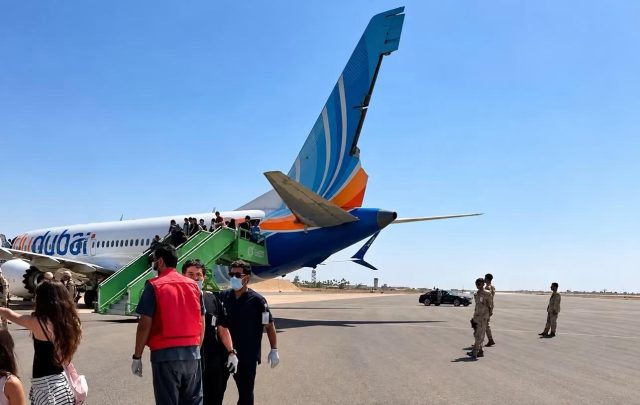
The facts are still developing. What is presently known is that FZ1073 transmitted the internationally recognised emergency code 7700 and subsequently, for a short period, the 7500 code associated with unlawful interference. The aircraft then descended rapidly (losing 16 000 feet in one minute) and diverted from its planned route before landing safely at Tabuk. Flight-tracking data confirms the sequence of emergency transponder codes and the diversion.
What caused the emergency, however, remains the critical question.
Reports emerging during the day alleged that a violent confrontation occurred in the cockpit between the two pilots, with one pilot reportedly attacking the other with a knife. Other accounts suggested an attempt to take control of the aircraft and deliberately crash it. Passengers and other qualified pilots reportedly became involved in bringing the situation under control. Both pilots were reportedly taken for medical treatment. These accounts are serious, but they remain allegations pending the completion of the relevant investigations.
This distinction is particularly important in aviation.

An emergency transponder code is not, by itself, proof of what caused an emergency. Squawk 7700 indicates a general emergency, while 7500 is used to indicate unlawful interference. The latter is therefore a significant security signal, but investigators still have to establish why it was selected, by whom, and in what circumstances. The subsequent return to 7700 and diversion to Tabuk provide important factual evidence, but they do not, on their own, establish motive or criminal intent.
The legal characterisation of the incident therefore matters. If the investigation establishes that a person intentionally attempted to seize control of the aircraft or otherwise interfere unlawfully with its operation, the incident would move beyond an ordinary flight-safety occurrence into the realm of aviation security and unlawful interference. International aviation law has long treated acts directed against the safety and security of civil aviation as matters requiring cooperation between states, particularly where an aircraft, its passengers, crew and several jurisdictions are involved.
That is precisely what makes FZ1073 unusual.
The flight originated in the United Arab Emirates, was bound for Israel, entered the airspace of other states and ultimately landed in Saudi Arabia. The aircraft therefore became the subject of a rapidly evolving multinational response. The fact that the aircraft was carrying a large number of Israeli passengers inevitably added a geopolitical dimension to an already serious aviation-security event.
Israeli officials publicly raised the possibility of an attempted terrorist attack, with National Security Minister Itamar Ben-Gvir describing the incident in those terms. Other Israeli reporting attributed an alleged intention to crash the aircraft to the pilot involved. These are official or media characterisations, rather than findings established by an investigation.
FlyDubai’s public position has, appropriately, been more restrained. The airline confirmed that an incident occurred on FZ1073, that the aircraft diverted to Tabuk and that all passengers were safe and accounted for. It stated that its teams were working with the relevant authorities and that further information would be provided as confirmed details became available.
That approach is important because aviation investigations depend upon evidence, not narratives.
The incident nevertheless raises a broader question for the industry: what happens when the greatest immediate threat to an aircraft may come from inside the cockpit itself?
Modern aviation security has traditionally concentrated heavily on preventing unauthorised persons from gaining access to the flight deck. FZ1073 reminds us that cockpit security also depends upon the integrity of those who are authorised to occupy it. Pilot incapacitation, violent conduct, deliberate interference and the ability of the remaining crew to maintain control of the aircraft are all matters that deserve careful consideration within aviation safety and security frameworks.
There is also an important lesson in the outcome. Whatever ultimately caused the emergency, the aircraft was recovered, diverted and landed safely. The response of the crew, passengers, air traffic services and authorities will form part of the evidence that investigators must examine.
For now, therefore, the responsible aviation position is simple: separate what is known from what is alleged.
FZ1073 landed safely. Its passengers survived. A serious incident occurred in or around the cockpit, triggering emergency procedures and an international security response. The precise sequence of events, the intentions of those involved and the legal character of the conduct must now be established through proper investigation.
In aviation, the investigation comes before the conclusion.
And sometimes, as FZ1073 demonstrates, understanding what happened inside the cockpit is as important to aviation security as understanding what happened in the sky.
About the Author:
At the intersection of cockpit, courtroom, and classroom, Dist. Prof Angelo Dube brings a rare, lived perspective to aviation. A commercial pilot and the Group Chairman of the Flying Jurist Group of Companies, he is also the driving force behind the Aviation Indaba – an influential platform shaping high-level industry dialogue across the continent.
In the global legal arena, he serves as President of the Society for International Aviation Law, while in academia he holds the position of Distinguished Professor (Aviation and Aeronautical Studies) within the College of Law at UNISA. There, he leads the Aviation Law Working Group – a dynamic collective of pilots, regulators, researchers, and legal minds pushing the boundaries of aviation law and policy. Prof Dube is also a founding member of the Engaged Scholarship on the Rural Aviation Economy (Project ESRAE) which seeks to optimise rural communities’ access to the aviation economy across South Africa.
He writes here not from a single vantage point, but from the confluence of them all – and in his personal capacity.